Addiction (66) Administrative Data Accelerator (1) Adolescents (2) African Studies (1) Aging (1) Alcohol (15) Artificial Intelligence (1) Award (5) Bennett Lecture (1) Biobehavioral Health (2) Brain Development (2) CCSA (56) Center for Health Care Policy Research (1) Certification (2) Child Development (2) Child Health (1) Child Maltreatment (2) Child Maltreatment Solutions Network (3) Child Study Center (1) Climate Change (1) College of Education (2) College of Health and Human Development (12) College of Information Sciences and Technology (2) College of Medicine (7) College of Nursing (2) College of the Liberal Arts (4) Community (4) Conference (7) COSSA (2) COVID-19 (2) Criminal Justice (11) Criminal Justice Research Center (5) Criminology (1) CSUA (58) CTSI (6) DEI (1) Demography (3) Depression (2) Domestic Abuse (2) Edna Bennett Pierce Prevention Research Center (7) Education (1) EIC (6) EIC Podcast (1) Employment (2) Faculty Information (2) Family (5) Fellowship (1) Friends (2) Funding (6) Gambling (2) Genetics (1) Geography (1) Geroscience and Dementia Prevention Consortium (1) Giving Tuesday (1) Government (2) Health Care (3) Health Policy and Administration (3) Housing (1) Huck (1) Human Development and Family Studies (9) Human Trafficking (2) IFSE Workshop (1) Impact (1) Inequities (1) Information Technology (1) Institutes of Energy and the Environment (1) Interventions (1) Latino (1) Law (1) Lecture (2) Legal Resources (1) Marijuana (2) Maternal Health (1) Mental Health (4) Mindfulness (4) Neurology (1) NIH (4) Obesity (2) Occupational Therapy (1) Open Access Research (1) Opioids (95) Overdose (6) Pain (4) Penn State Addiction Center for Translation (1) Penn State Law (1) Penn State Research (27) Podcast (3) Policymaking (6) PRC (1) Pregnancy (7) Prevention Research Center (11) Prevention Science (6) PRI (1) PROSPER (2) Psychiatry (1) Psychology (5) Public Health Sciences (2) Public Policy (2) Racial and Ethnic Minorities (2) Recovery (3) Research (6) Research Evidence (1) Research-to-Policy Collaboration (1) Respiratory Health (1) Rural Communities (3) Rural Health (2) Rural Sociology (1) School (1) Seed Funding (4) Sexual Minorities (1) SLEIC (1) Smoking (7) Social Science (12) Sociology (3) SSRI (33) SSRI Affiliates (1) SSRI Cofunds (12) SSRI Director (1) Stigma Summit (1) Stress (1) Substance Abuse (66) Substance Use (78) Suicide (3) Support Resources (1) Symposium (2) Tax Revenue (2) Teens (4) Tobacco (2) Transportation (1) Vaping (1) Veterans (1) Violence (1) Why Social Science? (2) Workshop (1) Zoom (1)

Long-term study of early brain and child development launches enrollment
Penn State researchers are launching enrollment for the largest long-term study of early brain and child development in the U.S. Penn State researchers aim to enroll 300 people, about 4% of the total cohort. The researchers will follow participants and their children from before birth through…
Penn State receives a five-year, nearly $6 million grant to study factors promoting early childhood development
The effects of genetics, home environment, and prenatal substance use on child health and brain development are largely unknown, even though pregnancy and early childhood are incredibly important periods of growth. To address this knowledge gap, Penn State…
Why Social Science? - Because It Provides Empirical Answers to Critical Public Health Questions
By Jeni L. Burnette, Ph.D., Associate Professor of Psychology & Sarah L. Desmarais, Ph.D., Professor of Psychology, North Carolina State University What do the opioid and obesity epidemics have in common? For starters, they are both public health crises in which the disease model is used to…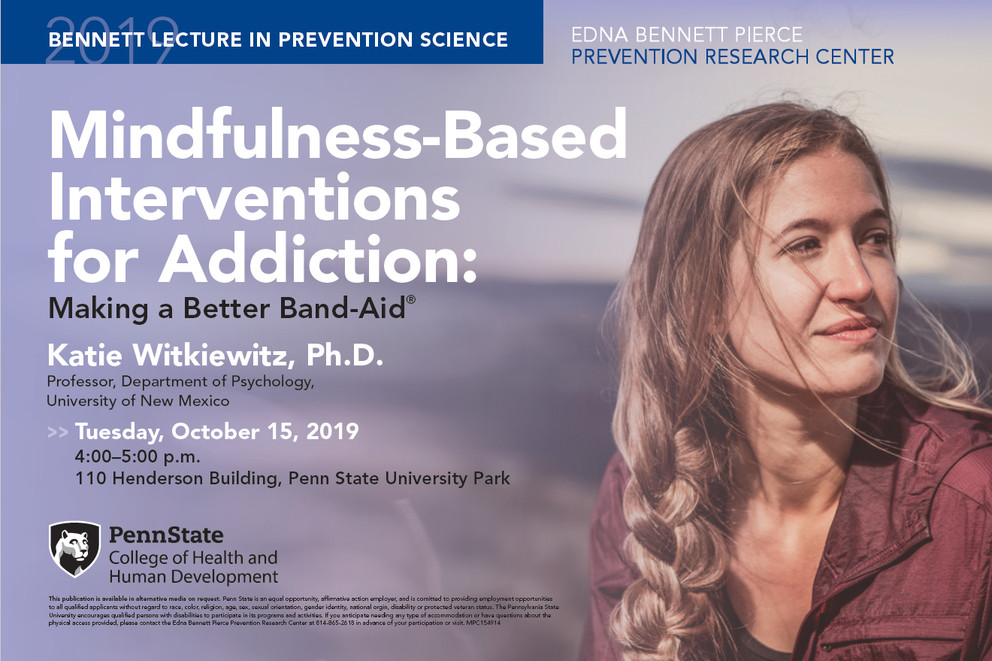
2019 Bennett Lecture to focus on mindfulness-based Interventions for addiction
On Oct. 15, at 4 p.m., Katie Witkiewitz, psychology professor at the University of New Mexico, will present the 2019 Bennett Lecture in Prevention Science, "Mindfulness-Based Interventions for Addiction: Making a Better Band-Aid," in 110 Henderson Building. The event is free and open to the public…